What Does “The Observer is the Observed” Mean?
Have you ever watched yourself watching something? Sounds confusing, right? But stay with me.
When you look at a tree, there’s the tree (the observed) and there’s you (the observer). Simple enough. But Krishnamurti said something deeper. He said the observer is the observed. The person looking is not separate from what they’re looking at.
This changes everything about how we live our daily lives.
How This Shows Up in Your Life
Think about the last time you got angry at someone. Maybe your colleague took credit for your work. Or your partner said something hurtful. In that moment, you felt anger. You thought “I am angry,” as if anger is something separate from you.
But here’s the truth: in that moment, you are the anger. There’s no separate “you” being angry. The anger and the angry person are one and the same.
This is what Krishnamurti meant. When we see this clearly, something shifts. We stop fighting our emotions. We stop running from them. We simply observe, and in that observation, transformation happens.
My Teachers: Milo, Kovu, and Cleo
My three pets teach me this truth every single day.
Milo chases food. That’s it. That’s his whole personality. When he sees food, he doesn’t think about it. He doesn’t plan. He doesn’t hesitate. He just becomes the chase. The chaser and the chased are one. There’s no separate Milo thinking “I want that food.” There’s just the movement of chasing. Pure, simple, complete.
Kovu chases his tail. Round and round he goes. He thinks he’s catching something separate from himself. But the tail is him. He’s chasing his own self. Sound familiar? This is exactly what we do. We chase happiness, success, peace, love, not realising these things are our own nature. We’re chasing ourselves, just like Kovu chases his tail. When he stops and looks confused, I wonder if we ever stop and look around too.
Cleo is just happy. No reason. No condition. Not “I’ll be happy when…” She doesn’t chase anything. She doesn’t seek anything. She lies in the sun, wags her tail for no reason, and radiates pure contentment. When I’m stressed, I look at Cleo. She’s not doing anything special. She’s just being. And suddenly, my stress doesn’t seem so real. The observer that was creating all that noise just dissolves.
These three creatures show me, every day, that life is simpler than my mind makes it.
When Travel Shows Me the Truth
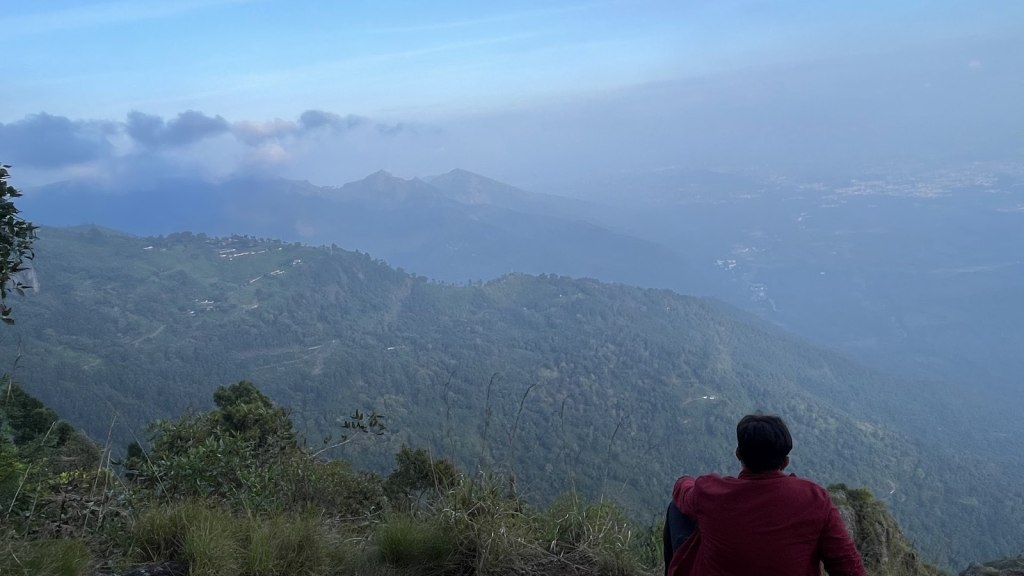
I visited Aizawl once, just for a few days. But something about those hills stayed with me.
Standing at a viewpoint, I watched the evening mist roll between the valleys. It didn’t announce itself. It just came, soft and unhurried, swallowing everything: the trees, the houses, the mountains. As I watched, the line between me and the mist blurred. There was no “me” standing apart. Just the mist, the hills, the quiet.
The observer became the observed.
Similarly, I remember sitting near a waterfall in Chiang Mai. Nothing famous, just a modest cascade hidden in the jungle. The water didn’t plan its fall. It didn’t worry about where it was going. It just fell, endlessly, completely. I sat there for hours, and somewhere along the way, the “me” who was watching faded. Only the waterfall remained: the sound, the spray, the endless flow.
No separation.
Why This Matters for Your Daily Life
You don’t need to go to Aizawl or Chiang Mai to experience this. It happens in small moments every day.
When you’re sipping your morning chai, really sipping it and not thinking about work, the tea and you become one.
When you’re watching the rain from your window, not naming it, not judging it, just watching, the rain and you merge.
When you’re ending your day, tired but peaceful, watching the stars without naming constellations, you and the stars are not separate.
These are not spiritual experiences. They are just life, lived fully, without the constant commentary of the observer.
What Krishnamurti Was Really Saying
Krishnamurti wasn’t giving us philosophy. He wasn’t creating a new religion. He was pointing to something we all experience but rarely notice.
Truth is a pathless land.
J. Krishnamurti
You can’t find it through someone else. You can’t learn it from books or gurus. You can only see it for yourself, in your own life, in your own moments.
The seeker is the sought. The one looking for peace is peace itself. The one wanting love is love itself.
When you stop chasing, you realise you’ve already arrived.
How to Live This Way
Be present while eating. When you eat your food, actually taste it. Don’t think about tomorrow’s meeting or yesterday’s argument.
Listen without planning. When someone speaks, just listen. Don’t prepare your response while they’re talking. Be fully there.
Watch your anger. When anger comes, don’t suppress it or express it. Just watch it. See it as a movement of energy, not as “you.” In that watching, it dissolves.
Spend time with your pets. If you have them, watch them. Really watch. They live this truth naturally. They don’t need to learn it.
Travel with awareness. When you visit new places, don’t just take photos. Be there. Let the place change you.
End your day quietly. Before sleeping, sit for a few minutes. Don’t think. Just watch your breath. Let the day settle.
Common Questions People Ask
Isn’t this just escapism? No. It’s the opposite. It’s facing reality without the filter of the “me.” It’s seeing things as they are, not as we want them to be.
Do I need to leave my job or family? Not at all. This is for everyday life. The shopkeeper, the office worker, the student can all live this way. It doesn’t require renunciation.
How long does it take? It’s not about time. It’s about attention. Transformation is instant when you see clearly, not gradual.
Is this the same as meditation? Meditation is often about concentration, focusing on one thing. This is about choiceless awareness: watching everything without preference or rejection.
Why This is Important Now
We’re living in a time of constant distraction. Scrolling, comparing, seeking, never satisfied. The observer in us is exhausted: always watching, always judging, always wanting.
Krishnamurti’s words are more relevant now than ever.
The ending of sorrow is the beginning of wisdom.
J. Krishnamurti
Sorrow ends when we stop creating division. When we see that we are not separate from our pain, our joy, our anger, our love. When we see that the observer is the observed.
Start Today
Don’t believe me. Don’t believe Krishnamurti. Experiment.
Today, when you’re walking, just walk. When you’re drinking water, just drink. When you’re angry, just watch. When you’re happy, just be.
See what happens.
You might discover that the person you’ve been searching for is the one doing the searching. The peace you’ve been chasing is the one doing the chasing.
The observer is the observed.
Not as a concept. As a lived truth.
Your Turn
Have you ever had a moment where the watcher and the watched became one? Maybe while watching your pet, or sitting by a waterfall, or just ending your day quietly?
Share in the comments. Let’s walk this pathless land together, not as followers, but as friends.
Quick Recap
What you learned:
- The observer is the observed: not philosophy but lived reality
- Our pets naturally live this truth (Milo, Kovu, Cleo)
- Travel and nature reveal this when we’re present
- You don’t need to escape life, just pay attention
- Transformation is instant, not gradual
- This is for everyone: office workers, students, parents
Three simple practices:
- Watch without naming
- Listen without planning
- Be without wanting
One quote to remember: “Truth is a pathless land,” said J. Krishnamurti.
If this resonated with you, share it with someone who needs to hear it. Sometimes a simple reminder is all we need to stop chasing and start living.
Related reading: If this resonated, you might also like The Art of Living by Thích Nhất Hạnh: Seven Ideas That Quietly Changed the Way I See Life.


Leave a Reply