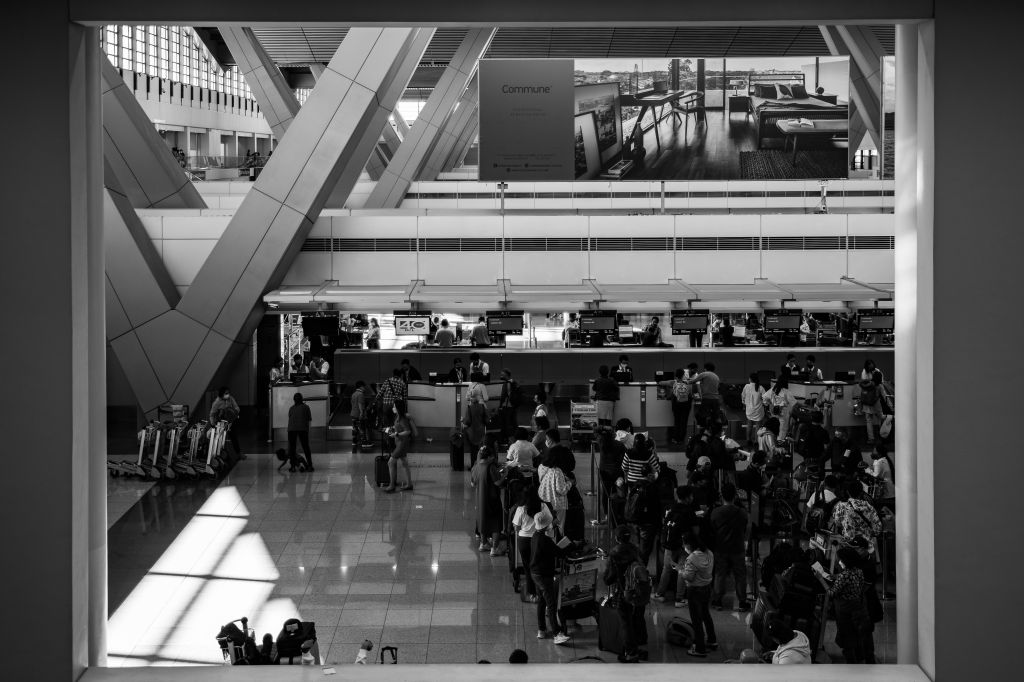
In my travel experiences, even when I’m the one taking off for a vacation myself, I find myself noticing things at the airport while I wait. A young couple were filming themselves at the check-in counter, doing the whole “start of our journey” vlog with a selfie stick, redoing the same three seconds until it looked right. Not far off, a large family group was talking loudly across the waiting area, laughing, calling out to each other, the kind of noise that fills up a room without meaning to. And near the gate, someone had pulled two or three chairs together and stretched out across them like it was their living room, shoes off, bag as a pillow. None of it was rude, exactly. Nobody was doing anything wrong. But it stayed with me, and it’s really what got me thinking about this piece.
Travel Has Changed. Have We?
I remember when a foreign trip was something you saved for years to take. It was planned around a wedding, or a big birthday, talked about for months before and after. Now it’s almost ordinary. Millions of us fly out every year, for holidays, for work, for a cousin’s graduation, for a long weekend that sometimes costs less than a weekend at home. Our passports have gotten stronger. The places we can visit visa-free keep growing. But I keep coming back to one question. Have our habits kept up with our budgets?
Most of Us Are Fine, Honestly
I want to say clearly that this isn’t about all Indian travellers, because most of the ones I’ve come across have been perfectly fine. I’ve stood behind families patiently managing tired kids in long queues. I’ve met young backpackers who clearly read up on local customs before landing anywhere. I’ve seen people leave a shared kitchen cleaner than they found it.
But that’s not usually what people remember. A single loud, entitled traveller caught on camera does more to shape how a billion people are seen than a thousand quiet, well-behaved ones ever will. It isn’t fair. It’s just how these things tend to work.
What I’ve Noticed, For What It’s Worth
Travelling through Thailand, Vietnam, Cambodia and Indonesia over the years, I noticed things that made me a little uneasy. Groups getting loud in restaurants that weren’t built for that kind of noise. People trying to bargain at a supermarket counter where the price was printed right there on the shelf. A group blocking a temple entrance for several minutes because the light was right for a video.
Then, travelling through parts of Western Europe, France, Belgium, the Netherlands, Switzerland, I noticed something closer to the opposite. People queued without needing to be told. Trains stayed quiet. There was a kind of care for the people around you that seemed to come naturally.
I want to be honest that this is just one person’s experience, not a study of any kind, and I’m sure I missed plenty of exceptions in both directions. Still, it left me wondering. Why does the same person often behave differently depending on which country they’ve landed in?
The Place Becomes a Backdrop
At some point, travel stopped being only about seeing somewhere new and became, at least partly, about proving you were there. Airports have turned into spaces for filming reels. Railway platforms double up as film sets. I’ve seen clips of people dancing in the middle of a crowded terminal, not really noticing the travellers trying to get past with their luggage.
I don’t think this makes anyone a bad person. But it’s a question worth sitting with quietly. When did the place we’re visiting become the backdrop, and the video become the actual point of the trip?
Habits We Carry Without Noticing
A lot of what feels completely normal at home simply doesn’t work the same way elsewhere, and usually nobody tells us in advance. Bargaining comes naturally in most Indian markets. Try that in a branded store in Europe and you’ll get a confused look, not a discount. In places where tipping is part of how service staff are paid, skipping it isn’t seen as being careful with money, it’s seen as being rude. Speaking loudly in Hindi on a quiet train, assuming no one nearby understands, doesn’t always go the way we expect. Neither does walking into a temple in clothes we’d wear at home without a thought.
None of this makes anyone a bad person either. These are just habits that were shaped somewhere else, and travel is often the first time we find that out.
When It Becomes a Story Online
Every so often a video makes the rounds. Someone arguing with hotel staff. A disturbance mid-flight. Strangers filmed without being asked. A few restaurants in parts of Europe have reportedly put up small signs about dining etiquette aimed at Indian guests specifically. There have been occasional reports of businesses in parts of Southeast Asia becoming more cautious with large Indian tour groups after a few bad experiences.
These are still exceptions. But they travel fast online, and somehow they’re the ones that stay in people’s minds.
This Isn’t Only About Us
Every country has its version of the difficult tourist. British holidaymakers have a reputation in parts of Spain. Australians have made headlines in Bali more than once. Americans get stereotyped as loud before they’ve said a word. Large Chinese tour groups have faced similar criticism in more than one country. Bad behaviour while travelling isn’t something unique to Indians. It’s a fairly human thing.
What has changed is how visible we’ve become. More of us are travelling than ever before, which also means more of us are being watched, and judged, than ever before.
So Why Does the Behaviour Change?
I don’t think we’re more disciplined in one country and less in another. It feels simpler than that. We tend to follow whatever is around us. When everyone is queueing, we queue. When a space is clean, we think twice before dropping something on the floor. When rules are clearly followed by everyone else, we follow them too, almost without noticing.
Good behaviour in public, I’ve started to think, isn’t only about personal values. It’s also shaped by habit, by what’s expected around us, and, if we’re honest, by a bit of quiet peer pressure. We’re probably not that different from anyone else. We just respond to whatever environment we’re placed in, the same way most people do.
A Few Things Worth Keeping in Mind
Do a little homework before you land. Tipping customs, dress codes, how queues work, none of it takes long to look up, and it saves you from learning it the hard way in public.
Remember shared spaces are shared. Airports, trains and monuments aren’t a personal film set. Try to keep the noise down and stay out of the way of people just trying to get where they’re going.
Don’t assume home rules travel with you. What feels normal here might not feel normal somewhere else, and that’s fine. It’s not a personal insult, it’s just a different place.
Ask before filming someone. And if a place says no photography, that’s not really a suggestion.
Remember you’re not only representing yourself. For better or worse, people often form an opinion of an entire country from the handful of citizens they happen to meet.
A Last Thought
The travellers I’ve admired most weren’t the ones who’d been to the most places. They were the ones who left things a little easier for the people around them, a bit more patient, a bit more willing to adjust to somewhere else’s way of doing things instead of expecting it to adjust to them.
I think that might be the only souvenir worth bringing home. Not something you can put on a shelf. Just the habit of being a decent guest, wherever you happen to be.
Related reading: If this resonated, you might also like 25 Travel Mistakes First-Time Travellers Make (And How to Avoid Them).
 rahulphukan.com
Leave a comment