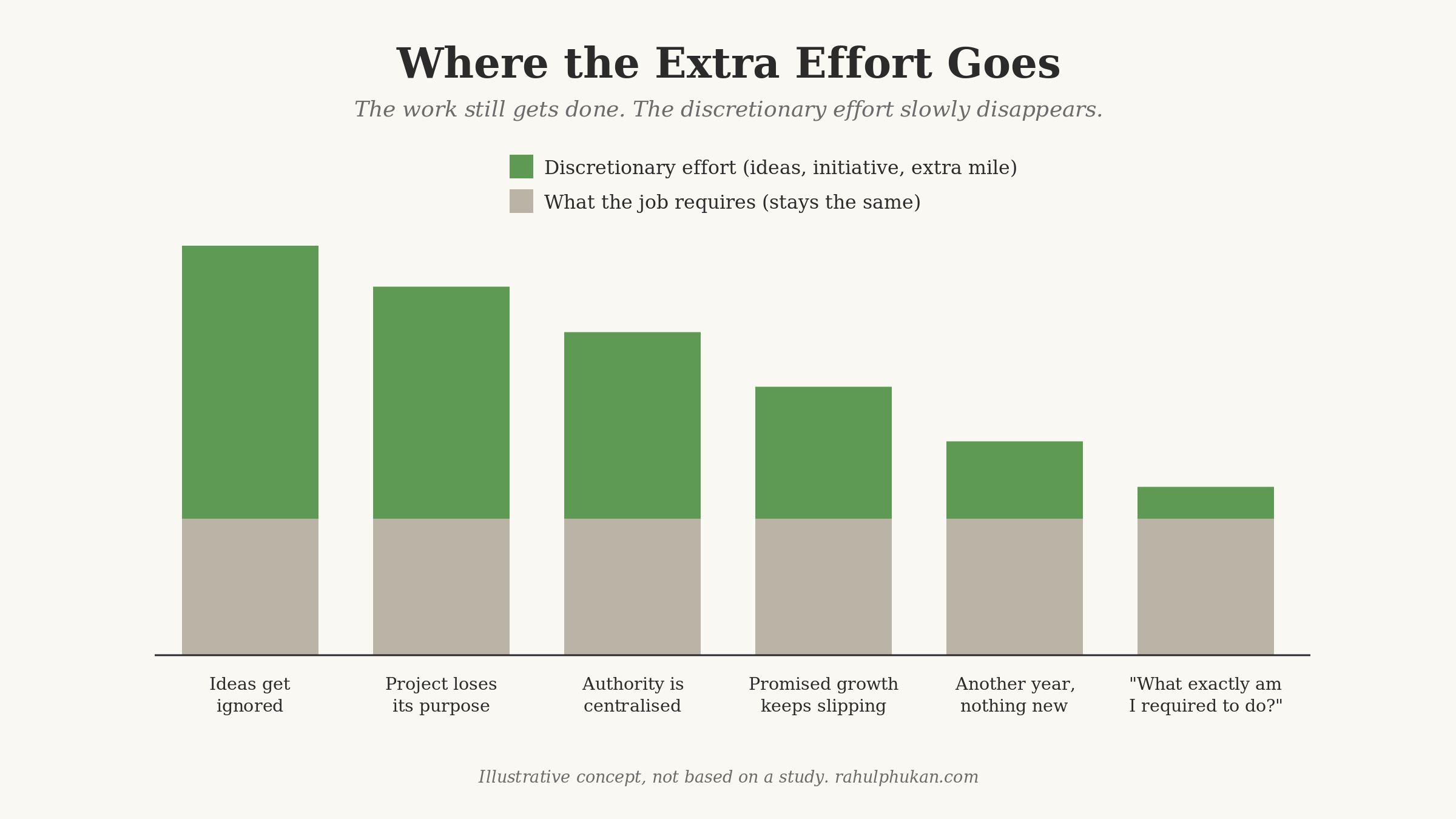
Every organisation has someone like this. They are the person you rarely worry about, because they volunteer for the difficult project, ask the awkward question and fix problems that technically belong to somebody else. Then, at some point, they stop. They still turn up and meet their deadlines. Nothing dramatic happens, and there is usually no complaint. But the ideas dry up, the challenges stop, and they become very good at doing exactly what is asked and nothing more.
In my observation, this is easy to miss because the work still gets done. What has gone is discretionary effort, the part of a person’s contribution that no job description can demand. Good employees seldom lose it because they have become worse people. More often, something has changed between them and the work.
What the Gallup numbers say about India
Gallup’s 2026 State of the Global Workplace report found that 23% of Indian employees were engaged at work in 2025, the lowest in four years and down from 33% in 2022. Another 59% were not engaged, and 18% were actively disengaged. (India’s trends are three-year rolling averages, so year-to-year movements are approximate.)
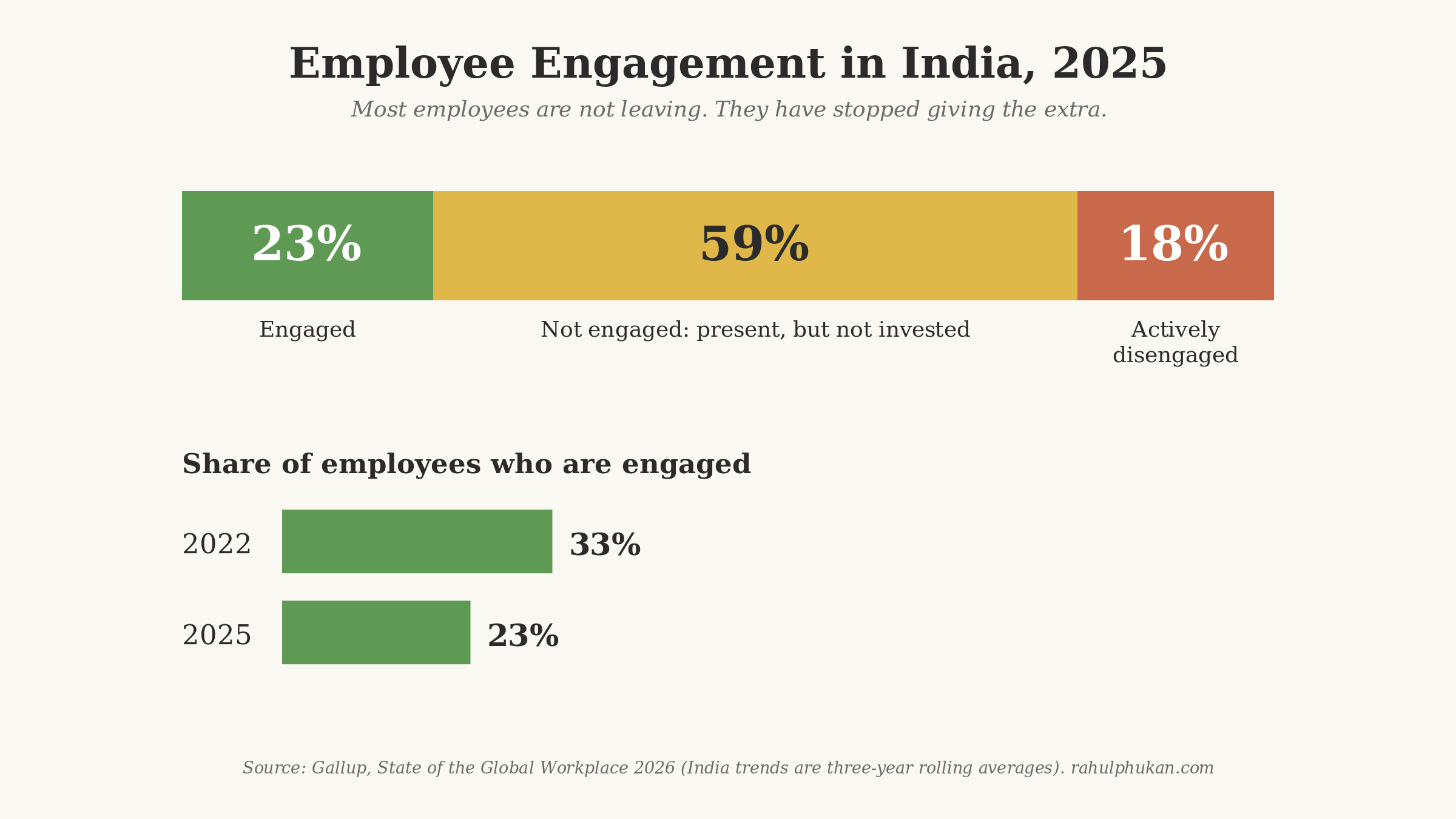
The 59% is the number I find most telling. These people have not walked out. They come in and do what is expected, but they have quietly stopped investing themselves. Most conversations about disengagement are about the people who leave. This is the group who stay, which makes the problem harder to spot and, I suspect, more expensive.
Why good people pull back
The usual explanation is motivation, and in India it often becomes a conversation about younger employees and work ethic. Organisational psychology offers a better starting point. The Job Demands–Resources model, developed by Arnold Bakker and Evangelia Demerouti, treats a job as a balance: workload, role conflict and uncertainty drain people, while autonomy, feedback and a chance to learn replenish them. A 2019 meta-analysis by Lesener, Gusy and Wolter supported the model’s core assumptions. So the better question is what the job takes from someone and what it gives back.
From what I have seen, four things tend to empty that second column.
The work stops making sense. It doesn’t need a grand mission. People need to know why a project matters and who it helps. Without that, effort starts to feel optional.
Authority gets taken away. A new leader centralises decisions, and someone who was trusted now needs approval for everything. A capable person can put up with a demanding quarter for a while. What wears them down is being responsible for an outcome they no longer control, which is the point of my Keep People In-Charge post.
Growth turns into a promise. “Your time will come.” “Once this project is done.” Delayed growth and indefinite growth are different things, and sooner or later the employee hears the second. Recent research backs this up. Truit Gray of Bowling Green State University, in a study published in Human Resource Management, found that when people felt their organisation had kept its promises on autonomy and fairness, they were less likely to quiet quit and more likely to mentor new joiners or take on extra work. When promises were broken, the pattern reversed.
Belonging stays on paper. It isn’t team lunches. It is whether your view carries weight in the room. Indian workplaces have hierarchies of age, seniority and title, and people know whose opinion counts, whatever the culture deck says. That gap is where trust starts to thin.
Gallup’s India survey with the Institute of Directors points the same way, with a caveat: it covered only 181 IOD members, so it reflects what directors believe. The leading factor, cited by 42%, was weak culture or values misalignment, and about 31% each cited lack of meaningful work, limited growth, poor recognition, limited autonomy and low trust in leadership. We tend to assume this is mostly about pay. These answers suggest something broader.
The manager is under pressure too
Gallup estimates that managers account for about 70% of the variance in team engagement. That is a correlation, so read it as “very large influence”, not proof of cause. Yet manager engagement in India fell from 39% to 30% between 2024 and 2025. Layers have been removed, teams are bigger, and there are targets from above and expectations from below. Gallup suggests flatter structures may be one factor. So I would stop treating the manager as the convenient villain. Sometimes the manager is the problem. Sometimes the manager is another symptom of it.
A better question than “how do I motivate them?”
Disengagement is rarely a single event. It builds up: an ignored idea, a project that stopped making sense, a promotion that never came. Eventually the person who asked “how can we make this better?” starts asking “what exactly am I required to do?” That is the warning sign.
Good employees don’t usually stop trying because they stopped caring. In my understanding, they stop because, over time, the organisation gave them fewer reasons to care. Discretionary effort can’t be demanded. It isn’t in a job description, and no policy can make someone care. People give it where they feel something is given back. So when a reliable person goes quiet, I would ask what changed, and whether it has anything to do with me. The answer often sits in decisions leaders made without noticing, and those can be made differently.
Somewhere between the employee who once cared deeply and the one who now does exactly what is asked, something changed. Finding out what it was is a leader’s job, and it is better done while the person is still in the room.
Sources
- Gallup, Rebuilding Indian Workplaces for the Future (2026)
- Gallup, State of the Global Workplace 2026
- Truit Gray, Bowling Green State University, study in Human Resource Management on psychological contracts and quiet quitting, as reported in BGSU’s 2025 news release
- Lesener, Gusy and Wolter (2019), “The job demands-resources model: A meta-analytic review of longitudinal studies”, Work & Stress, 33(1), 76–103
Related reading: More Leadership, Less Ego


Leave a Reply