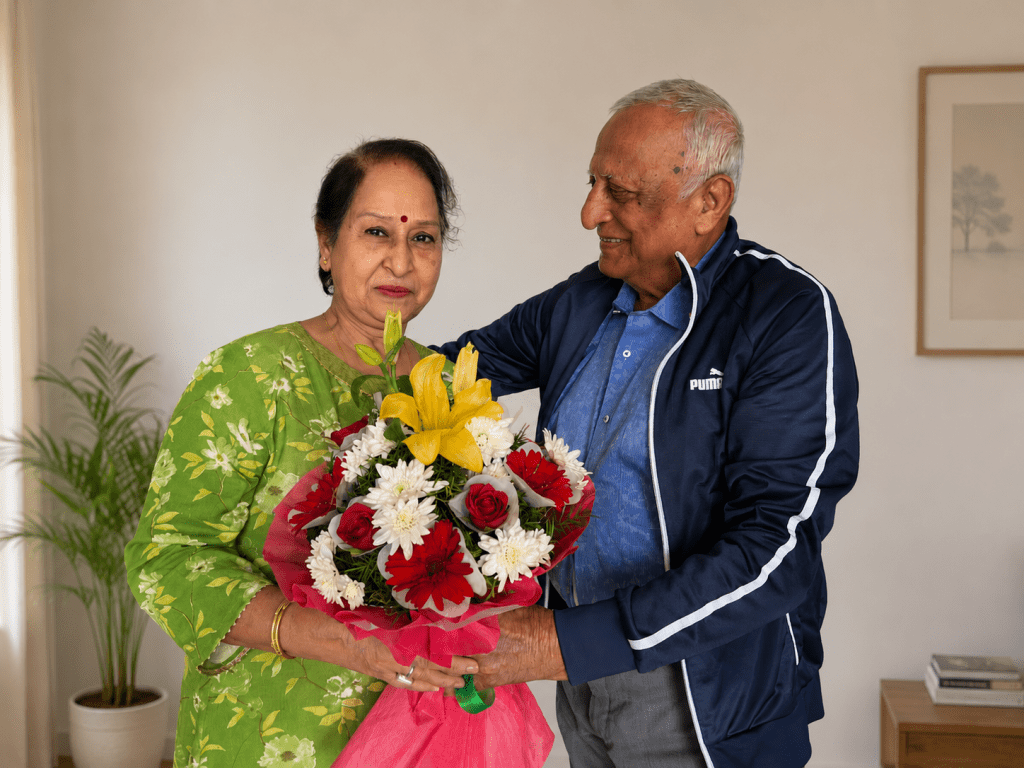
I left home at six and grew up between visits. It took me years to realise that while I was busy becoming an adult, my parents were quietly growing older too. This is an essay about time: not the kind measured by clocks, but the kind measured by memory, distance and love.
I don’t remember the exact day I started thinking about time. But I remember the day I left home.
I was six years old.
Old enough to carry a small suitcase. Too young to understand what leaving really meant.
Like many children from the Northeast, I went to boarding school. At that age, time wasn’t measured in years but in holidays. The school calendar became my clock. Home wasn’t somewhere I returned to every evening; it was somewhere I visited after months. Looking back, I realise something I never understood as a child: I didn’t grow up with my parents. I grew up between visits.
As life unfolded, I moved from Jorhat to Shillong, then to Delhi and Bangalore. I studied law, built a career, made lifelong friends, learned from remarkable mentors and slowly became someone very different from the little boy who had left home with an oversized school bag. Like most people, I thought I was the one changing.
It took me much longer to realise that while I was busy becoming an adult, my parents were changing too. I just wasn’t there often enough to notice it.
That’s what distance does. It doesn’t make time move faster; it simply hides the small changes. You don’t notice the first grey hair or the first wrinkle. You don’t see someone begin to walk a little more slowly. You notice the difference only when you meet again. Time rarely surprises us in everyday life. It surprises us in reunions.
Then another thought occurred to me. Perhaps my parents experienced exactly the same thing.
They never saw the ordinary days that shaped me. They weren’t there for the late-night studying, the failures that quietly built resilience, the books that changed my thinking, the friendships that shaped my values or the countless small moments that slowly became my life. They met me in snapshots too.
Perhaps somewhere in their minds, I still carry traces of the six-year-old who left home.
The strange thing is that I do exactly the same with them.
Part of me still sees my father as someone who could solve every problem. Part of me still sees my mother as someone who could somehow make everything feel alright. Reality has moved on, but memory often hasn’t. Maybe that’s what love does. It preserves people: not as they are today, but as they once lived inside us.
The more I reflected on this, the more I realised that time changes us in two very different ways. The first is obvious. Our bodies grow older. Hair turns grey, faces soften and energy changes. The second is much quieter. Time reshapes our minds. It changes what we admire, what we fear and what we choose to hold on to. The arguments we once felt compelled to win no longer seem worth having. Ambition slowly makes room for perspective. We begin to value peace over proving a point.
Perhaps growing older isn’t simply becoming older. Perhaps it’s becoming someone else, so gradually that we rarely notice it ourselves.
One thought has stayed with me more than any other. Perhaps time doesn’t move differently. Perhaps we do.
Physically, we all travel at roughly the same pace. Every birthday marks another year. But emotionally, we rarely grow together. While I was learning to become independent, my parents were learning to let go. While I was building a career, they were entering a different stage of their own lives. We were all changing, just not in front of one another.
Maybe that’s why families sometimes struggle to understand each other. Not because they don’t love one another, but because everyone is carrying a different timeline. Parents remember the child. Children remember the parent. Neither fully sees the person standing before them today.
As I’ve grown older, I’ve found myself asking my parents different questions. Not because they’ve changed, but because I have. I want to know about their childhoods, their fears, the dreams they once had and the difficult choices they made. Before they were my parents, they were simply people trying to figure life out, just as I am today. That realisation didn’t come with age alone. It came with perspective.
Philosophers have wrestled with the idea of time for centuries. The Buddha spoke of impermanence. Marcus Aurelius reminded himself that nothing lasts forever. Saint Augustine confessed that he understood time until someone asked him to explain it. They all approached it differently, yet they seemed to circle the same truth: time isn’t simply something that passes. It’s something that transforms.
These days, when I go home, I stay a little longer at the dining table. I listen more carefully. I ask one more question before ending a conversation. Not because I suddenly have more time, but because I understand its value differently. I’ve realised that a meaningful life isn’t built only from extraordinary moments. More often, it’s built from ordinary conversations, shared meals and quiet evenings that don’t seem important until they become memories.
So, is time real?
Physics has one answer. Philosophy has another.
I don’t know which is right.
What I do know is that time quietly shapes every person we love and every version of ourselves. It teaches us that people cannot be understood through a single moment because none of us is finished. We are all still becoming.
The real question isn’t whether we can slow time down; we can’t. The question is whether we’ll notice the people changing alongside us while we still have the chance.
Because one day, the photographs on the wall won’t simply remind us how much time has passed.
They’ll remind us how much life quietly happened while we were busy looking ahead.
And perhaps that is all time has ever wanted us to understand.
Related reading: If this resonated, you might also like The Art of Living by Thích Nhất Hạnh: Seven Ideas That Quietly Changed the Way I See Life.

 rahulphukan.com
Leave a comment