
The higher you go in an organisation, the fewer people tell you that you’re wrong. I noticed this in other people first, and it took me longer to see it in myself. Nobody announces it. Meetings get a little smoother, disagreement turns into polite silence, and you start believing things are going well because nobody is saying otherwise.
Amy Edmondson, who studies teams at Harvard, ran into a version of this in hospitals. She expected the best units to make the fewest mistakes. They reported the most. They weren’t careless. People there felt safe enough to say that something had gone wrong, while the units reporting few errors weren’t necessarily making few. I think about that finding often, because it applies well beyond hospitals. A quiet team is not always a healthy one.
Early on, I wanted to be good at the work, preferably among the best, and I wanted people to know it. I don’t think that’s a bad ambition. But being good at your craft and being good at leading people turn out to be different skills, and it took me a while to accept that the first doesn’t automatically give you the second.
Start with taking a stand. As people become senior, many start avoiding clear positions. Every argument gets balanced, every option stays open, and nobody is upset. It looks like fairness, but often it’s just comfort. I’ve seen enough drifting decisions to know that not deciding is also a decision, and usually an expensive one, because the cost arrives later and lands on someone else.
So I think a leader should be willing to take an unpopular position. How it gets taken matters, though. When I’m sure about something for good reasons, I can explain it, and I’m fine if someone pokes holes in it. When I’m sure because I can’t stand the thought of being wrong, my explanations get shorter and my tone gets sharper. That’s usually my cue that ego is talking. People don’t have to agree with a decision, but they should understand why it was made, and if the facts change, the decision should too. Changing your mind for good reasons isn’t weakness. Holding on to a view you no longer believe just to look consistent is worse.
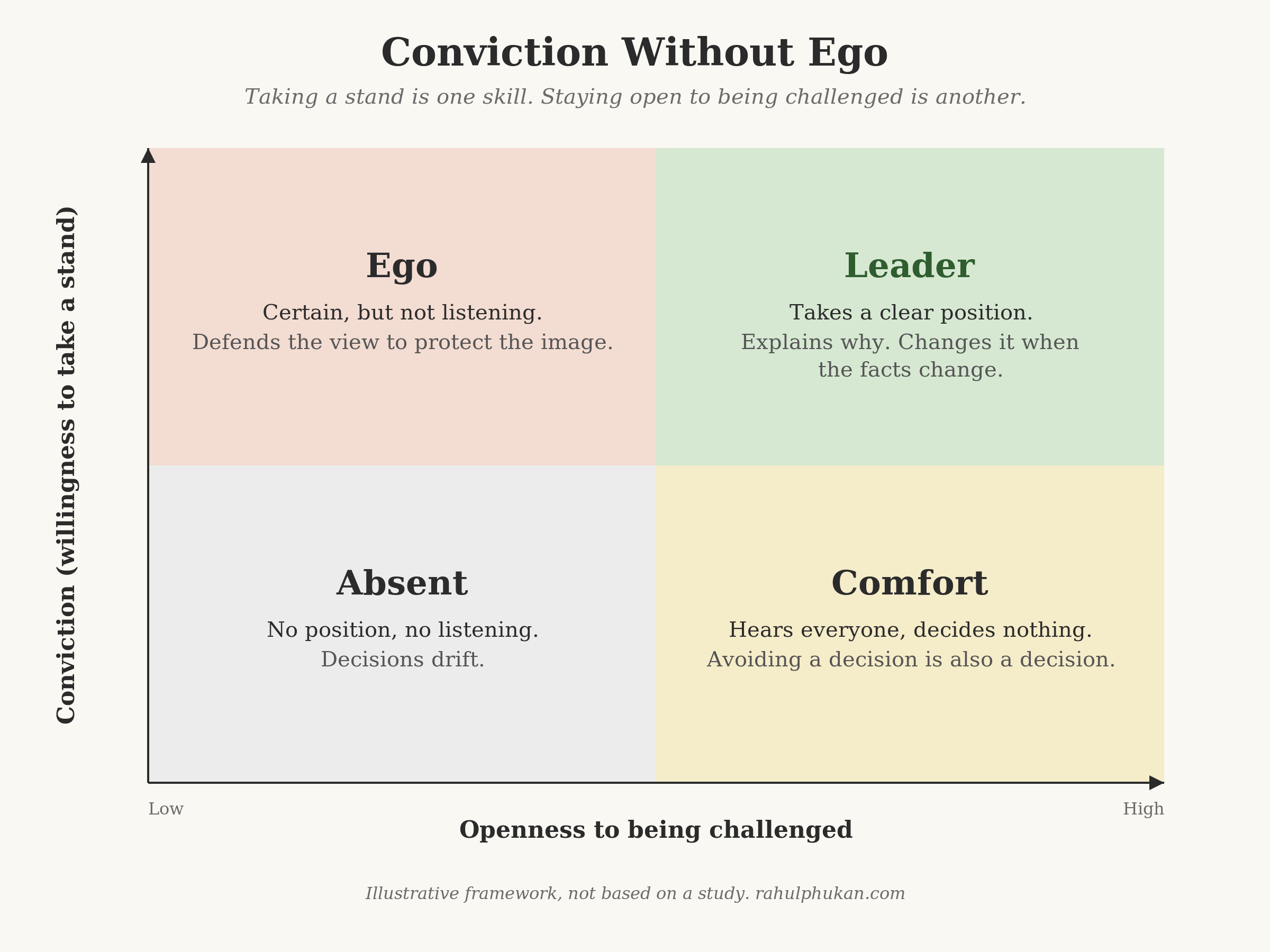
Listening is the harder part. A lot of workplace conversations are two people waiting for their turn. I’ve done it too, nodding while already composing my reply. Sometimes people don’t want a solution at all. They want to know someone understood the problem, or that their work was noticed. What looks like a disagreement over process is often something else: unclear expectations, a trust problem, a feeling of being left out. If you only deal with the stated issue, you can solve the wrong problem very efficiently.
The same goes for someone who is struggling. The quick conclusion is that they aren’t up to it. Before reaching it, I’d want to know whether the expectations were clear, whether they had the tools and the time, whether something outside work was getting in the way. Sometimes it does turn out to be a lack of ownership, and then it’s a different conversation. Being kind and holding people to a standard aren’t opposites. People tend to improve most when they hear both, that someone believes they can do better and that someone is telling them plainly where they’re falling short. What doesn’t work is demanding accountability from a person you haven’t given the authority to act. That’s really the idea behind what I call Keep People In-Charge, which I’ve written about separately.
Letting go was the part I found hardest. There’s a quiet satisfaction in being the person everyone comes to. You know how things work, you approve things, you fix things, and it feels like being useful. For a while it is. Then you notice that people have stopped bringing you solutions and started bringing you problems, because they’ve learnt you’ll take care of it. I’ve caught myself stepping in to correct something that didn’t need correcting, and realising later that I had taken a decision away from someone who would have made it perfectly well, only differently. If I want people to develop judgement, they have to be allowed to use it, including getting some of it wrong.
Nobody is indispensable, and I’ve come to think a leader who works hard at appearing indispensable has a problem. Information gets held back, approvals pile up, and the organisation slowly shapes itself around one person. Sometimes that comes from wanting high standards. Often, if I’m honest, it comes from wanting to stay relevant. A well-run place shouldn’t stall because one person is on leave.
So the measure I’d choose isn’t how much falls apart when a leader is away. It’s how much keeps growing. When someone you mentored runs a project you used to run, and does it differently and better, that’s the thing worth having done.
None of this makes me less ambitious or less interested in high standards. Organisations need people who will decide and take responsibility. It’s only that none of it requires making everything about me.
A leader is a leader when they have created other leaders who now lead. That’s the measure I’d like to be held to.
Related reading: As You Rise, Bend More


Leave a Reply